
What a florist does
O*NET, the U.S. Department of Labor's occupation database, describes the job in one line: design, cut and arrange live, dried or artificial flowers and foliage. Day to day that means meeting customers, recommending flowers that fit their budget and occasion, buying from wholesalers, building the arrangements, and handling orders, phones and deliveries.
Florists who do weddings and events also decorate venues: ceremony arches, centerpieces, installations. Common job titles include florist, floral designer, floral studio designer, wedding decorator and floral business owner.
| Employer | Share of floral designers |
|---|---|
| Florist shops | 55% |
| Grocery and specialty food stores | 19% |
| Self-employed | 14% |
| Wholesale trade | 4% |
| Administrative and support services | 1% |
How to become a florist, step by step
There is no single required route. This is the order most people follow, whichever path they choose.
Learn the basics
Flower care and processing, cutting stems, tying bows, simple arrangements. BLS says this is where new designers start, usually alongside an experienced florist.
Get hands-on experience
Work in a flower shop or a grocery floral department. BLS notes many part-time and seasonal openings around Christmas, Valentine's Day and Mother's Day.
Add formal training if you want it
A high school floral class, a floral school course, a community college certificate or degree, or a registered apprenticeship. Formal training helps most if you plan to run your own business or lead a team.
Consider certification once you have experience
The AIFD Certified Floral Designer (CFD) is the best-known credential. It is optional; it proves design skill, not business skill.
Build a portfolio and learn to price
Photograph every piece and keep its recipe: stems, supplies, time and price. Practise with the free calculators until pricing is a habit.
Take paid work
A shop job, freelance work for an established studio, or your own clients. Weddings and events are the work BLS expects demand to continue for.
The main paths, compared
BLS says most floral designers learn on the job over a few months; it classes the training as moderate-term, meaning more than one month and up to a year. Formal programs take longer and cost money, but they add business subjects and a route to certification.
| Path | Time | Example |
|---|---|---|
| Shop or grocery floral job | A few months on the job | Paid from day one; BLS's most common route |
| High school floral class and FFA | A semester to a year | Texas offers a one-credit Floral Design course in grades 9–12 |
| Private floral school course | Days to weeks | Texas A&M's Benz School starts with a two-week Basic Design Class open to anyone |
| Community college certificate | About 9 months and up | Bucks County Community College's noncredit certificate: 102 hours, electives and a capstone |
| Associate degree | About 2 years | Cuyamaca College's Floral Design A.S.: 33 major units plus general education |
| University concentration | 4 years | Mississippi State's Floral Management concentration, with work in the university's own flower shop |
| Registered apprenticeship | 2,000 hours | Floral Designer is on the U.S. Department of Labor's list of apprenticeable occupations |
Floral design schools by state →Floristry for high school students →
What florists earn
Floral designers earned a median $37,360 a year, or $17.96 an hour, in May 2025. The lowest 10% earned under $28,600 and the highest 10% over $51,000. Wholesale employers paid the highest median by industry, $40,530, and florist shops $36,870.
Those BLS figures leave out the 14% of floral designers who are self-employed. An owner's income is whatever their prices leave after flowers, supplies, labor and overhead, which is why pricing is the skill to learn early.
Is floristry a growing career?
Honestly, not in shop jobs. BLS projects floral designer jobs to fall 6% from 45,200 in 2025 to 42,700 in 2035, because more orders are placed online through delivery services. It still expects about 5,200 openings a year as people retire or change careers, and it expects demand for wedding and funeral arrangements to continue.
So if you want to build your own business, weddings and events are a sensible focus. The design work is the same; the difference is that you run the proposals, contracts, deposits and orders yourself.
Certification: helpful, not required
The American Institute of Floral Designers awards the Certified Floral Designer (CFD) through three routes: courses at an AIFD Education Partner, a once-a-year hands-on evaluation, or the student competition at its Symposium. Each route ends with an online test that needs 80% or better.
State florist associations run their own programs too. In Texas, the TSFA certifications are on the state's list of industry certifications for high schools.
The skill new florists underestimate: pricing
Wedding florists interviewed by the Society of American Florists build foam, cages, moss, delivery and labor into every price; one said the labor charge is sometimes greater than the flowers. In SAF's 2026 business outlook, one wedding florist admitted: "I'm looking at the invoices for current weddings and praying that I charged enough."
Students meet the same math early. FFA's Floriculture competition includes a retail pricing practicum with a 3x markup on fresh flowers. The 3x habit: flowers, supplies and labor, times 3, rounded up to the next $5. The free calculators below use your numbers, so practise until it is automatic.
Florists using Fiory
Proof it works: a luxury wedding studio on Fiory
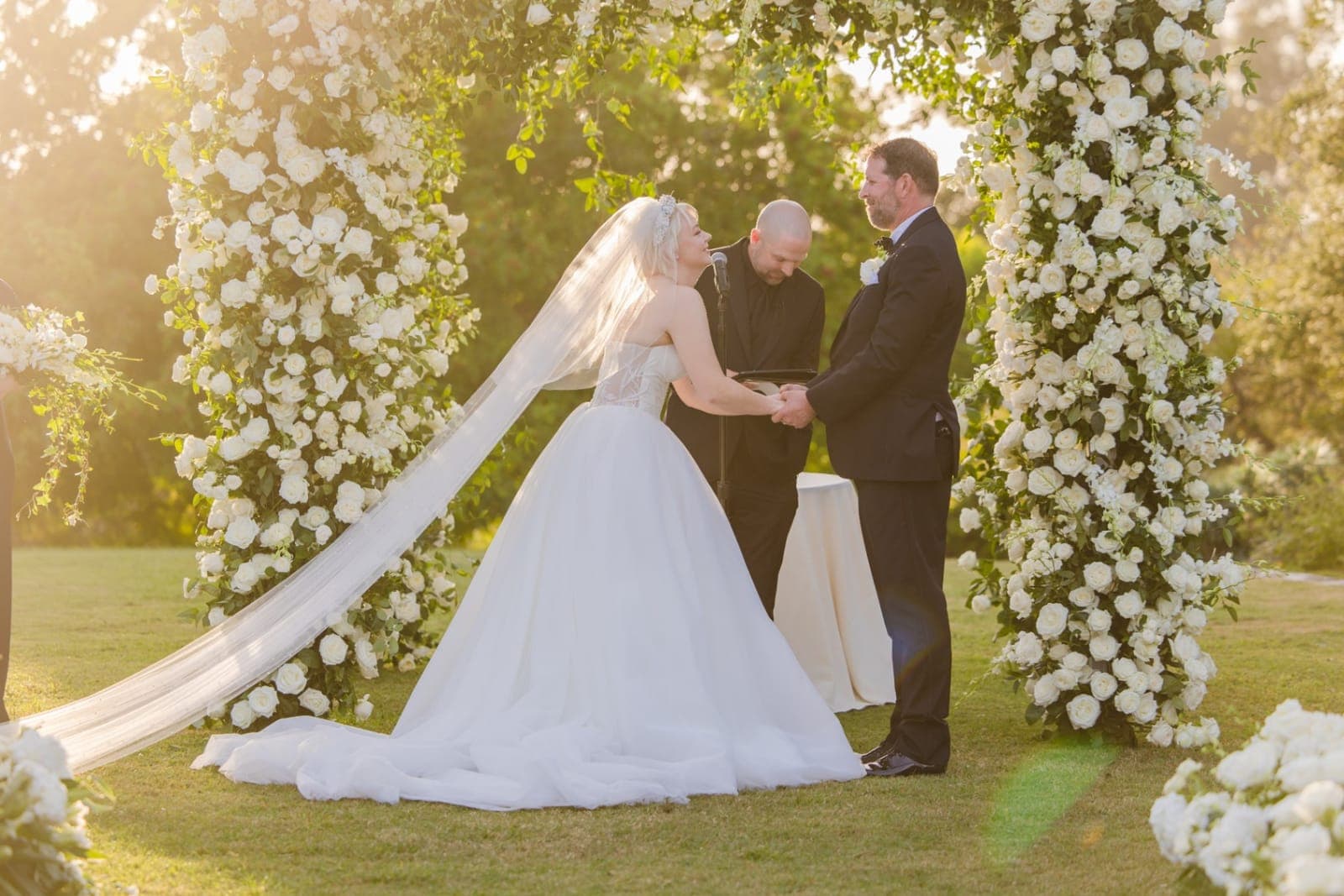
CHIC Flowers is a luxury wedding florist in San Diego and Los Angeles, featured in Vogue, Brides and Haute Living. It uses Fiory, including the AI agent, and its Fiory-built website organizes the portfolio venue by venue. Its main site, chicflowers.com, grew from a five-page portfolio to more than 150 pages, including 40 venue pages.
It also teaches the path this page describes. Chic Academy is its online school for retail florists ready to break into weddings, covering consultations, pricing and execution, taught by a working wedding florist.
- pages on chicflowers.com
- 150+
- venue pages
- 40
- featured in
- Vogue, Brides, Haute Living
chicflowers.com ↗Its Fiory website ↗Chic Academy ↗Read the case study →More florist sites built with Fiory →
Full disclosure: CHIC Flowers is the studio of Fiory's founder.
Start your floral journey with Fiory
You do not need software to learn floristry. You need good pricing habits from the start, and a system the day people start paying you. Here is what Fiory gives you at each stage.
1. While you learn
18 free florist calculators
Price a bridal bouquet, a centerpiece or a ceremony arch from wholesale stem costs, labor and markup. Free, in your browser. Practise on real numbers before anyone pays you.
Open the calculators →2. While you learn
Lens: price any arrangement photo
Upload a photo of an arrangement. Lens names the flowers, counts the stems and works out wholesale cost, labor, markup and a retail price. Free.
Try Lens →3. Your first paid wedding
The AI agent prices it from your numbers
Paste a couple's email and their inspiration photos into Fiory. The AI agent creates the client and the event, picks pieces from your library, writes stem-by-stem recipes for new ones and prices everything from your own costs, labor and tax. A new piece is priced at 3 times its flowers, supplies and labor, rounded up to the next $5, and marked for you to review. Nothing reaches the couple until you send it.
See how the AI agent works →4. When you open your studio
Proposal, contract, payments and website in one plan
Send the proposal, have the contract signed online, take deposits into your own Stripe account and publish a florist website on your own domain. One plan, $138 a month after a 14-day free trial, with 20 AI credits a month.
Start the 14-day free trial ↗
Questions people ask
No. BLS lists a high school diploma or equivalent as the typical entry-level education, and in O*NET's survey 71% of respondents said new hires need a high school diploma. Certificates and degrees help if you want to run your own business or move up to chief designer.
BLS says new designers learn on the job over a few months; it classes the training as more than one month and up to a year. Formal programs range from two-week courses to two-year associate degrees and four-year university concentrations.
Floral designers earned a median $37,360 a year ($17.96 an hour) in May 2025, per BLS. The lowest 10% earned under $28,600 and the highest 10% over $51,000. Self-employed florists are not included in those figures.
It suits people who are artistic, organised and good with customers, the qualities BLS lists. Shop jobs are projected to decline 6% from 2025 to 2035, but about 5,200 openings a year are still expected, and demand for wedding and funeral work is expected to continue.
Shops and grocery floral departments hire part-time and seasonal help, especially around Christmas, Valentine's Day and Mother's Day. Rules for working under 18 vary by state, so check yours.
No. You can learn and practise pricing with Fiory's free calculators and the free Lens photo tool. Fiory's paid plan is for florists taking paid orders: proposals, contracts, payments and a website, with an AI agent that prices from your own numbers. It is $138 a month after a 14-day free trial.
Sources, checked November 2026
Wages, program details and certification rules change. Check the source before you enroll, apply or pay a fee.
- U.S. Bureau of Labor Statistics, Occupational Outlook Handbook: Floral Designers (pay May 2025; projections 2025–35)
- BLS Occupational Outlook Handbook: How to Become a Floral Designer
- BLS: education and training categories (moderate-term on-the-job training)
- O*NET OnLine: Floral Designers, 27-1023.00
- O*NET OnLine: Floral Designers wages, national and by state (BLS 2025 data)
- U.S. Department of Labor, Office of Apprenticeship: list of apprenticeable occupations, rev. March 2020 (Floral Designer, 2,000 hours)
- Texas Administrative Code, 19 TAC §127.53: Floral Design (One Credit)
- Texas A&M University: Benz School of Floral Design
- Bucks County Community College: Floral Design Certificate
- Cuyamaca College: Floral Design A.S. and Certificate of Achievement (2026–27 catalog)
- Mississippi State University: Floral Management studies
- American Institute of Floral Designers (AIFD): Becoming a CFD
- Texas State Florists' Association (TSFA): high school certifications
- Texas Education Agency: 2025–2030 Industry-Based Certification list
- National FFA: Floriculture Career Development Event
- SAF Floral Management: how savvy event florists stay profitable (May 2022)
- SAF: Practical answers for an uncertain business climate (August 2026)