
Is floristry right for you?
BLS lists four qualities floral designers need: artistic ability, creativity, customer-service skills and organizational skills. O*NET adds visualization, color discrimination and finger dexterity, and its interest profile for the job is Realistic, Artistic and Conventional: hands-on, creative and orderly.
Know the trade-offs too. The busiest weeks are Christmas, Valentine's Day and Mother's Day, and wedding work happens on weekends. You are on your feet, working with water, cold rooms and sharp tools.
- You notice color and like making things with your hands
- You like helping people choose something for an important day
- You can work fast and stay organised when it gets busy
- You are curious about running your own business one day
Classes to take in high school
Ask your agriculture teacher or career and technical education (CTE) counselor what your school offers. Floral design is taught as a CTE course in many states. Three examples:
- Art and design: color theory and composition carry straight over
- Business or marketing: you will price, sell and keep records
- Agriculture or plant science: how flowers grow and how to keep them fresh
| State | Course | What it covers |
|---|---|---|
| Texas | Floral Design (one credit), grades 9–12 | Design elements and principles, contemporary and specialty design, floral business management and botany |
| Utah | Floriculture (0.5 credit), grades 9–12 | Corsages, boutonnieres, wedding and sympathy pieces, markup and pricing; ends with a skill certification test |
| California | Ornamental Horticulture pathway | A state standard on basic floral design principles |
FFA Floriculture
If your school has an FFA chapter, the Floriculture Career Development Event (CDE) is the national floral competition for high school students. FFA says it tests employment readiness, plant identification and maintenance, and sales practices. Teams have four members.
The national handbook includes a 20-minute floral arrangement practicum and a retail pricing practicum that uses a 3x markup on fresh flowers and 2x on hard goods. That is a contest convention, not an industry rule, but it is the same habit professionals use.
Working in a flower shop can also count as your Supervised Agricultural Experience (SAE); FFA places retail floral work under Agricultural Sales in its SAE awards. And AIFD invites FFA students aged 16 and over to its 2027 Symposium in St. Louis at a student rate of $579, up to 50 places.
| Event | Points | Format |
|---|---|---|
| Team activity | 800 | 45 minutes, for example packing floral products for an event or building a display |
| Identification | 200 | 40 plants, tools and disorders in 25 minutes |
| General knowledge exam | 175 | 35 questions in 50 minutes |
| Practicums | 100 each | Floral arrangement (20 minutes), growing procedures, retail pricing, plus a rotating practicum |
Certifications you can earn as a student
In Texas, students enrolled in a floral or approved art class can take the Texas State Florists' Association certifications at student prices: the knowledge-based test is $30, Level 1 is $100 to $120 in person or $75 to $85 virtually, and Level 2 is $135. All three are on the Texas Education Agency's 2025–2030 list of industry-based certifications for public schools.
Utah's Floriculture course ends with a state skill certification test. Later, in college, an AIFD student chapter can lead to the Certified Floral Designer through the student competition.
First jobs, internships and scholarships
Most floral designers work in florist shops (55%) or grocery floral departments (19%), and BLS notes many part-time and seasonal openings around the big holidays. Those are the easiest first jobs to get: processing flowers, cleaning buckets, wrapping orders, then simple arrangements.
Wisconsin runs a one-year Floral/Greenhouse Youth Apprenticeship for high school students, with competencies that include customer service, sales and creating floral arrangements. Ask your school whether your state has something similar.
The American Floral Endowment offers more than 35 scholarships a year, from $500 to $35,000, for floriculture and horticulture students, and paid internships such as the Mosmiller program: 10 to 16 weeks at a retail, wholesale or allied business with a $2,000 scholarship. Check AFE's eligibility rules.
After graduation: your options
You can go straight to work or keep studying. None of these closes the door on the others.
| Option | Good if you | Next step |
|---|---|---|
| Work in a shop | Want to earn and learn now | Apply before Valentine's Day or Mother's Day, when shops hire |
| Floral school course | Want fast, hands-on training | Short courses run from days to a few weeks |
| Community college | Want a certificate or degree and business classes | Look for an AIFD Education Partner or a program with an internship |
| University | Want management or horticulture careers | A few universities offer floral management concentrations |
| Apprenticeship | Want structured, paid training | Floral Designer is a registered apprenticeable occupation: 2,000 hours |
Practise pricing now
Pricing is the part most new florists get wrong, and you can practise it today. The 3x habit: flowers, supplies and labor, times 3, rounded up to the next $5. A centerpiece with $30 of flowers and supplies and $10 of labor comes to $120. Those are example numbers; real stem costs change with the season.
Use the free calculators to price bouquets and centerpieces, and Lens to price a photo of any arrangement you admire. Keep the results in your portfolio next to the photo: a florist who can explain a price stands out in an interview.
Florists using Fiory
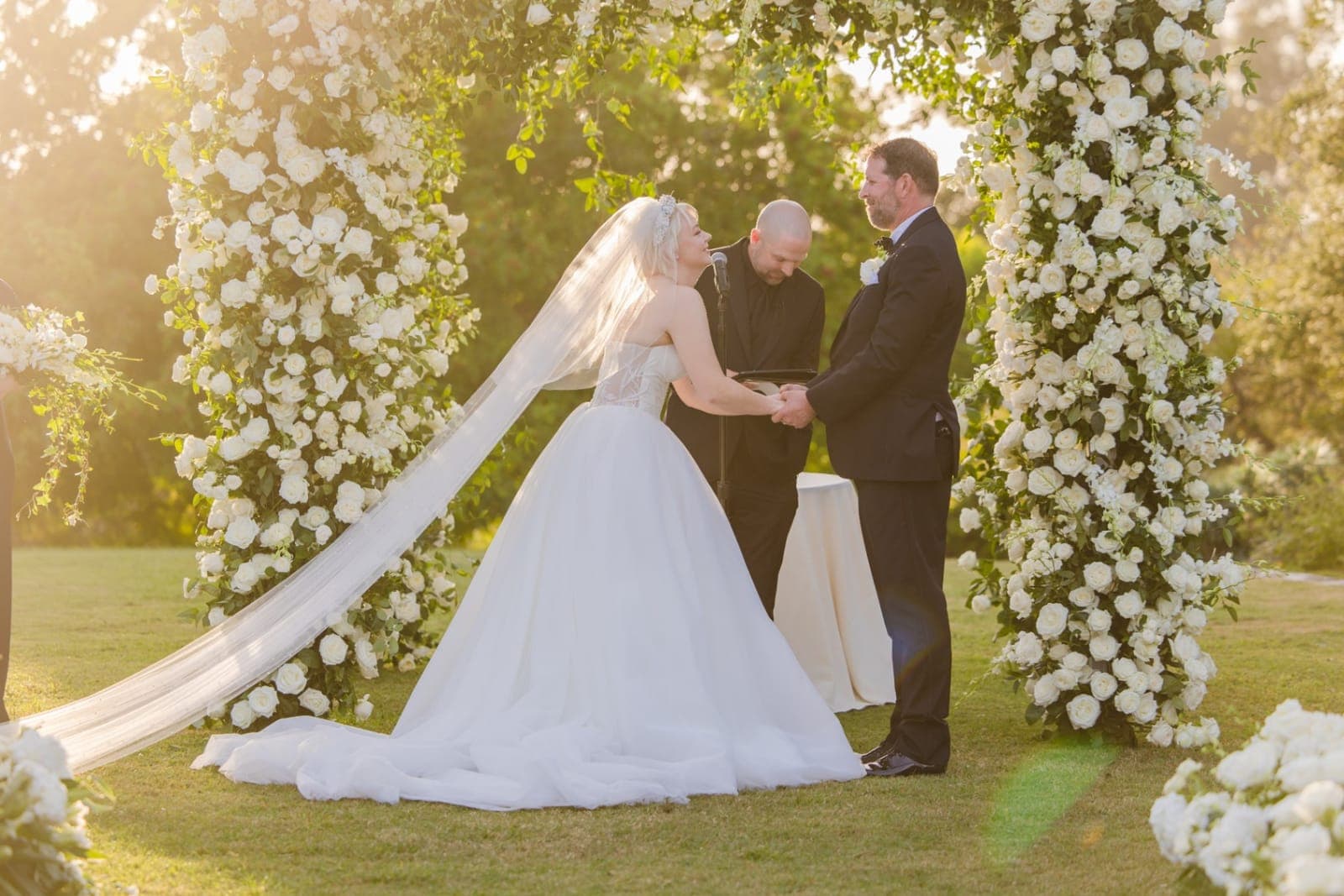
Proof it works: a luxury wedding studio on Fiory
CHIC Flowers is a luxury wedding florist in San Diego and Los Angeles, featured in Vogue, Brides and Haute Living. It uses Fiory, including the AI agent, and its Fiory-built website organizes the portfolio venue by venue. Its main site, chicflowers.com, grew from a five-page portfolio to more than 150 pages, including 40 venue pages.
It also teaches the path this page describes. Chic Academy is its online school for retail florists ready to break into weddings, covering consultations, pricing and execution, taught by a working wedding florist.
- pages on chicflowers.com
- 150+
- venue pages
- 40
- featured in
- Vogue, Brides, Haute Living
chicflowers.com ↗Its Fiory website ↗Chic Academy ↗Read the case study →More florist sites built with Fiory →
Full disclosure: CHIC Flowers is the studio of Fiory's founder.
Start your floral journey with Fiory
You do not need software to learn floristry. You need good pricing habits from the start, and a system the day people start paying you. Here is what Fiory gives you at each stage.
1. While you learn
18 free florist calculators
Price a bridal bouquet, a centerpiece or a ceremony arch from wholesale stem costs, labor and markup. Free, in your browser. Practise on real numbers before anyone pays you.
Open the calculators →2. While you learn
Lens: price any arrangement photo
Upload a photo of an arrangement. Lens names the flowers, counts the stems and works out wholesale cost, labor, markup and a retail price. Free.
Try Lens →3. Your first paid wedding
The AI agent prices it from your numbers
Paste a couple's email and their inspiration photos into Fiory. The AI agent creates the client and the event, picks pieces from your library, writes stem-by-stem recipes for new ones and prices everything from your own costs, labor and tax. A new piece is priced at 3 times its flowers, supplies and labor, rounded up to the next $5, and marked for you to review. Nothing reaches the couple until you send it.
See how the AI agent works →4. When you open your studio
Proposal, contract, payments and website in one plan
Send the proposal, have the contract signed online, take deposits into your own Stripe account and publish a florist website on your own domain. One plan, $138 a month after a 14-day free trial, with 20 AI credits a month.
Start the 14-day free trial ↗
Questions people ask
Yes, many students do. BLS notes many part-time and seasonal openings around Christmas, Valentine's Day and Mother's Day. Rules on hours and tasks for workers under 18 vary by state.
No. BLS lists a high school diploma as the typical education, and most florists learn on the job in a few months. College helps if you want to run a business or move into management.
It is FFA's national floral competition for teams of four high school students. Students identify plants and tools, take a knowledge exam, and complete practicums such as a 20-minute floral arrangement and retail pricing.
Yes. The American Floral Endowment awards more than 35 scholarships a year, from $500 to $35,000, to floriculture and horticulture students. Community colleges and state florist associations offer others.
Clear photos of your best pieces, each with its recipe (stems, supplies and time) and the price you would charge. Add any certifications, competitions and shop experience.
Yes: the calculators and the Lens photo tool are free. Fiory's paid plan is software for florists taking paid orders; when you start doing weddings, it is $138 a month after a 14-day free trial.
Sources, checked November 2026
Wages, program details and certification rules change. Check the source before you enroll, apply or pay a fee.
- U.S. Bureau of Labor Statistics, Occupational Outlook Handbook: Floral Designers (pay May 2025; projections 2025–35)
- O*NET OnLine: Floral Designers, 27-1023.00
- Texas Administrative Code, 19 TAC §127.53: Floral Design (One Credit)
- Utah State Board of Education: Floriculture CTE strand
- California Department of Education: CTE Ornamental Horticulture standard F11.0
- National FFA: Floriculture Career Development Event
- National FFA: Floriculture CDE resources and national handbook
- National FFA: SAE Awards (formerly proficiency awards)
- AIFD: Bringing FFA to AIFD at the 2027 Symposium
- Texas State Florists' Association (TSFA): high school certifications
- Texas Education Agency: 2025–2030 Industry-Based Certification list
- Wisconsin DWD: Floral/Greenhouse Youth Apprenticeship (DETA-18825, rev. 08/2025)
- American Floral Endowment: scholarships
- American Floral Endowment: internships
- U.S. Department of Labor, Office of Apprenticeship: list of apprenticeable occupations, rev. March 2020 (Floral Designer, 2,000 hours)
- AIFD: SAIFD Student Competition