
Three kinds of AI a florist meets
Most of what gets called AI in a flower business falls into three groups. They differ in one important way: whether the tool knows your own prices, flowers and clients.
| Kind | What it does | Examples |
|---|---|---|
| Chat tools | Answer questions and draft text from what you type in; they do not know your prices or stock | ChatGPT, Gemini; SAF's members-only Ask Aster, trained on SAF's own content |
| AI features inside software | Do one job inside a tool you already use | BloomNation's Lili writes product descriptions from photos, drafts review replies and suggests card messages |
| AI agents | Do multi-step tasks with your own data, then wait for you to approve | Fiory's AI agent turns a pasted inquiry into an event and a priced proposal from your library and rates |
How florists are using AI now
The industry's own events show where it is heading. The Society of American Florists' 2026 convention ran sessions on building a weekly flower-order tool ("it recommends, you decide"), using AI and video to train staff, and summarizing sales reports. AIFD's 2026 Symposium put "AI + Floristry: From Concept to Creation" on its main stage.
In shops and studios, florists use it for:
- Marketing: product descriptions, captions, emails and website copy
- Customer service: drafting replies, and after-hours support (one Virginia florist is preparing an AI support agent he calls Rosie)
- Wedding sales: turning an inquiry into a priced proposal from the florist's own prices
- Training: assistants built on a shop's own procedures, such as SAF's NotebookLM for Florists course
- Ordering: wholesalers use AI to forecast holiday demand and flag accounts
What the data says
There is no published survey of florists' AI use yet, so the best guides are national business surveys. They define "using AI" differently, which is why the numbers differ so much.
- Since October 2026, the Census survey words its question as "Super Intelligence or SI (formerly referred to as Artificial Intelligence or AI)"
- Among Census firms that use AI, sales and marketing is the most common use (52%)
- The Federal Reserve found accuracy is the top challenge for small businesses using AI (46%)
| Survey | Finding | Who and when |
|---|---|---|
| Census Bureau BTOS | 25.0% of all businesses used AI in a business function in the past two weeks; 24.0% in the retail group that includes florists | Representative sample, Oct 19–Nov 1, 2026 |
| Census Bureau BTOS | 23.4% of businesses with 1–4 employees, 44.0% with 250 or more | Same survey |
| Federal Reserve Small Business Credit Survey | 46% of small employer firms use AI; 83% of them for writing or marketing; 7% have fully integrated it | 6,525 firms, fall 2025 |
| U.S. Chamber of Commerce | 66% of small businesses use AI | Online survey of 3,732 firms, summer 2026 |
Couples are already using it
Zola's 2026 First Look Report found that 54% of couples use AI in some way to plan their wedding, 40% use it to draft emails to vendors or guests, and 31% use image tools for décor, attire or floral inspiration. In a smaller survey of 228 engaged couples, The Knot found 36% actively using AI.
For florists, that means more inquiries written with AI, and more AI-generated inspiration images that may show arrangements no florist can build.
The limits and risks
AI is useful for drafts and checks. These are the places it goes wrong for florists.
- Impossible images: florists report AI pictures with flowers that do not exist and installations that are not structurally logical. One Virginia studio described a bouquet "so impossibly lush it looks like it swallowed a florist's entire cooler"
- Prices: a chat tool does not know your stem costs, labor or markup, so its prices are guesses. Price from your own numbers, or use software that does
- Client privacy: consumer ChatGPT may use what you type to train its models unless you turn that off; OpenAI's business tiers and Google Workspace do not train on your data by default
- Reviews: the FTC's rule, in force since October 2024, bans fake reviews, including AI-generated ones, with civil penalties of up to $53,088 per violation
- Bots: California law makes it unlawful to use an undisclosed bot online to mislead people about its artificial identity in order to sell to them
- Copyright: the U.S. Copyright Office says prompts alone do not make AI output copyrightable; your photos of real arrangements are your work
Will AI replace florists?
The evidence so far says no. The Minneapolis Fed found about 96% of AI-using businesses reported no change in employment. Floral design is hands-on work with a perishable product, and the industry's own voices describe AI as an assistant: a wholesale buyer wrote that "AI can recognize patterns, but it cannot always explain them," and BloomNation says its assistant is meant to "support florists' craft and businesses, not replace or misrepresent them."
What changes is the business side. Florists who reply faster, price consistently and check their paperwork will compete better, whatever tools they use.
Where to go next
Pick the guide that fits where you are.
Step-by-step plan for any flower business →30-day plan for wedding florists →AI tools for florists, job by job →ChatGPT for florists →Teaching AI: module for instructors →
Florists using Fiory
A real wedding studio that runs on Fiory
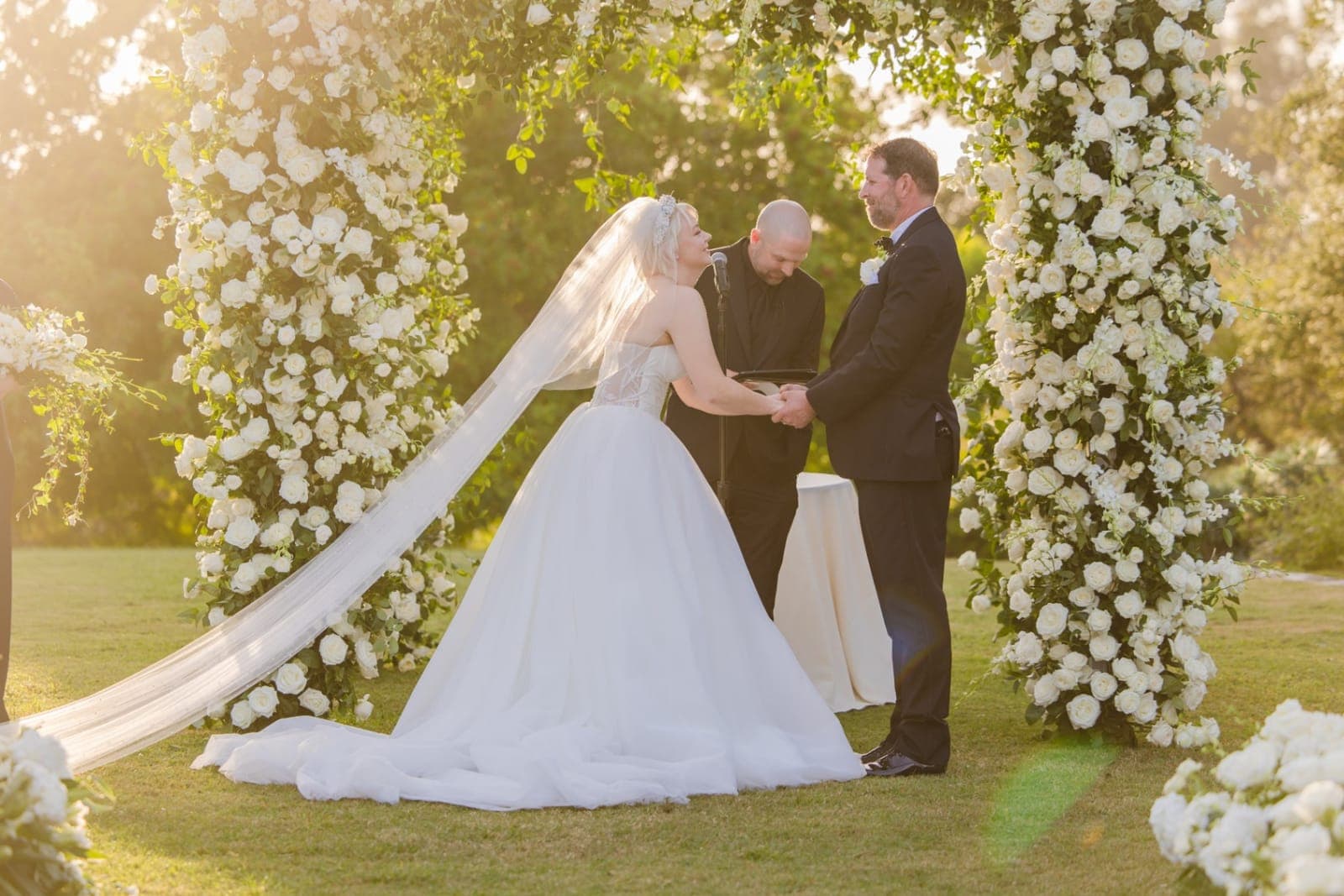
CHIC Flowers is a luxury wedding florist in San Diego and Los Angeles, featured in Vogue, Brides and Haute Living. It uses Fiory, including the AI agent, and its Fiory-built website organizes the portfolio venue by venue. Its main site, chicflowers.com, grew from a five-page portfolio to more than 150 pages, including 40 venue pages.
It is not a custom setup: the AI agent it uses is the one described on this page, included in the one Fiory plan every florist gets.
- pages on chicflowers.com
- 150+
- venue pages
- 40
- featured in
- Vogue, Brides, Haute Living
chicflowers.com ↗Its Fiory website ↗Read the case study →More florist sites built with Fiory →
Full disclosure: CHIC Flowers is the studio of Fiory's founder.
Put AI to work in your studio with Fiory
AI is only as good as the numbers and the rules you give it. Here is the order we suggest.
1. Before any AI
Get your own numbers straight
Know your stem costs, supplies, labor rate and markup. The free calculators and Lens show the math, so you can tell when an AI price is wrong.
Open the calculators →2. Your next inquiry
Try the AI agent on a real inquiry
Paste a couple's email and their inspiration photos into Fiory. The AI agent creates the client and the event, picks pieces from your library, writes stem-by-stem recipes for new ones and prices everything from your own costs, labor and tax. A new piece is priced at 3 times its flowers, supplies and labor, rounded up to the next $5, and marked for you to review. Nothing reaches the couple until you send it. It works during the 14-day free trial.
See how the AI agent works →3. Once it is booked
Let it check the paperwork
Ask the agent to check the contract for placeholders, missing facts and amounts that disagree with the event, set up a payment schedule with your usual retainer, and prepare the week's supplier report of stems and bunches. You approve every step.
What else the agent does →4. When it earns its place
Proposal, contract, payments and website in one plan
Send the proposal, have the contract signed online, take deposits into your own Stripe account and publish a florist website on your own domain. One plan, $138 a month after a 14-day free trial, with 20 AI credits a month.
Start the 14-day free trial ↗
Questions people ask
Software that drafts, checks and organizes the business side of flower work: replies, proposals, product descriptions, forecasts and training notes. It ranges from chat tools like ChatGPT to AI agents that work with a florist's own prices and clients.
It can generate images and suggest recipes, but it cannot build anything, and its images often show flowers or shapes that are not possible. Use AI images as a starting point for a conversation, and price only what you can actually make.
The evidence so far says no: the Minneapolis Fed found about 96% of AI-using businesses reported no change in employment. Design and client relationships stay with people; AI takes on drafts and checks.
Be careful. Consumer ChatGPT may use what you type to train its models unless you turn that setting off. OpenAI's business tiers do not train on your data by default. Never paste card numbers or anything a client would not want shared.
The SBA calls disclosure an expected best practice, and California law requires bots that sell to people online to disclose that they are bots. Never post AI-written reviews: the FTC bans them.
Chat tools for writing, AI features inside florist and website software, and AI agents like Fiory's for proposals. Our job-by-job guide compares them.
Sources, checked November 2026
Wages, program details and certification rules change. Check the source before you enroll, apply or pay a fee.
- U.S. Census Bureau: Business Trends and Outlook Survey, national, sector and subsector data (collected Nov 2–15, 2026)
- U.S. Census Bureau working paper CES-WP-26-25: AI use by business function (April 2026)
- Federal Reserve Bank of Minneapolis: AI adoption in business grows steadily but unevenly (May 2026)
- Federal Reserve Small Business Credit Survey: 2026 Report on Employer Firms
- U.S. Chamber of Commerce: Empowering Small Business, 2026 edition
- SAF: SAF launches AI business consultant (Ask Aster), January 2026
- SAF Amelia Island 2026 convention schedule (AI sessions)
- SAF: How successful florists stay ahead of change (June 2026)
- SAF Floral Education Hub: NotebookLM for Florists course
- AIFD Elevate 2026 Symposium brochure (AI sessions)
- Floral Daily: BloomNation launches Lili, AI-powered assistant (May 2026)
- WF&FSA: AI in floral distribution, forecasting and sales (September 2026)
- Zola: The First Look Report 2026
- The Knot Worldwide: Future of Marriage, 2026 trends (survey of 228 engaged couples)
- WeddingPro: How wedding pros use AI (survey of 1,400 wedding vendors)
- J. Morris Flowers: A realistic guide to AI wedding flower inspiration (August 2026)
- OpenAI Help: How your data is used to improve model performance
- OpenAI: Enterprise privacy (ChatGPT Business, Enterprise, Edu and API)
- Google Workspace: generative AI privacy hub
- FTC: Final rule banning fake reviews and testimonials (August 2024)
- FTC: fake review warning letter template (December 2025)
- California Business and Professions Code §17941 (bot disclosure)
- U.S. Copyright Office: Copyright and Artificial Intelligence, Part 2, Copyrightability (January 2025)
- U.S. Small Business Administration: AI for small business