
Do florists need to be certified?
Not to get hired: BLS lists a high school diploma and on-the-job training as the typical way in. Certification is useful as proof of design skill when you change jobs, teach, compete or market your own studio.
Three routes to the CFD
Every route ends with AIFD's online test, based on The AIFD Guide to Floral Design, which you must pass with 80% or better.
Education route
Take courses at an AIFD Education Partner, an approved state floral association or a Student AIFD chapter. If your instructor judges your work to be at CFD level, they submit you during an application window (August 1 to December 1, or March 1 to 31). You pay the $179 exam fee, which includes recertification fees through June 30, and pass the online test within two weeks of getting access.
Professional Floral Design Evaluation (PFDE)
Pass the online test, then a four-hour hands-on evaluation of five designs, held once a year. The 2027 PFDE is in St. Louis during AIFD's July 11–14 Symposium; registration typically closes in early to mid-April.
Student competition
Members of a Student AIFD chapter who average 7.0 at the Symposium student competition, with no design below 6.5, are recommended for the CFD and then take the online test.
The PFDE in detail
The PFDE is the route for working designers without a partner program. AIFD's published details:
| Item | Detail |
|---|---|
| Cost | About $2,250 plus flights and hotel; the required textbook is $129 |
| Online test | About 55 questions in 45 minutes, 80% to pass, two tries included |
| Hands-on categories | Wedding, Flowers to Wear, Arrangement, Sympathy, Designer's Choice |
| Materials | Identical for every candidate; you bring your own knife, pruners, ribbon shears, wire cutters and pliers |
| Judging | Seven AIFD Certified Evaluators score line, color, balance, proportion, dominance, contrast, rhythm, unity, mechanics and creativity, 1 to 5 each; high and low scores are dropped |
| Passing | A cumulative 16.0 (3.2 average) with no design below 2.95 earns the CFD |
| Places | About 100 a year, first come, first served |
| Results | Generally within 4 to 8 weeks; you can retake at a reduced rate after 3 months |
Keeping the CFD
CFDs pay annual dues of $244 ($194 with the early-bird rate) and earn 25 continuing education units every three years; the renewal form is free. AIFD's Symposium counts toward those units. A CFD who earned the credential through an Education Partner gets a one-time $250 discount on the PFDE within three years.
State and association certifications
Several state florist associations and the Society of American Florists run their own programs.
| Credential | From | What it takes |
|---|---|---|
| Knowledge-based test | Texas State Florists' Association | Proctored test on flower ID, tools, terms, care and handling; $50 for professionals |
| Level 1 floral designer | TSFA | 70+ on the knowledge test, plus a timed symmetrical arrangement and boutonniere; $350 professional bundle |
| Level 2 floral designer | TSFA | Level 1 and a portfolio, then an asymmetrical design, corsage and vase design in 90 minutes; $350 |
| Texas Master Florist | TSFA | 3 to 5 years' experience recommended; qualifying exam, 7 online classes, 3 hands-on sessions and a final; $2,420 for members |
| Arizona Master Florist | Arizona State Florists Association | 10 modules, offered twice a year; $950 |
| American Academy of Floriculture (AAF) | Society of American Florists | At least 5 years full time in the industry, 3 years of SAF membership and community service |
Certifications for high school students
Texas students in a floral or approved art class can take the TSFA knowledge test for $30 and Level 1 for $75 to $120. All three TSFA certifications are on the Texas Education Agency's 2025–2030 industry-based certification list, as is the Benz School's Principles of Floral Design certification. Utah's Floriculture course ends with a state skill certification test.
What certification does not cover
The PFDE scores design: line, color, balance, mechanics, creativity. It does not test pricing, proposals, contracts or deposits, which is where new studio owners most often lose money. Learn those on the job, in a business course, and by pricing every design you make.
Florists using Fiory
Proof it works: a luxury wedding studio on Fiory
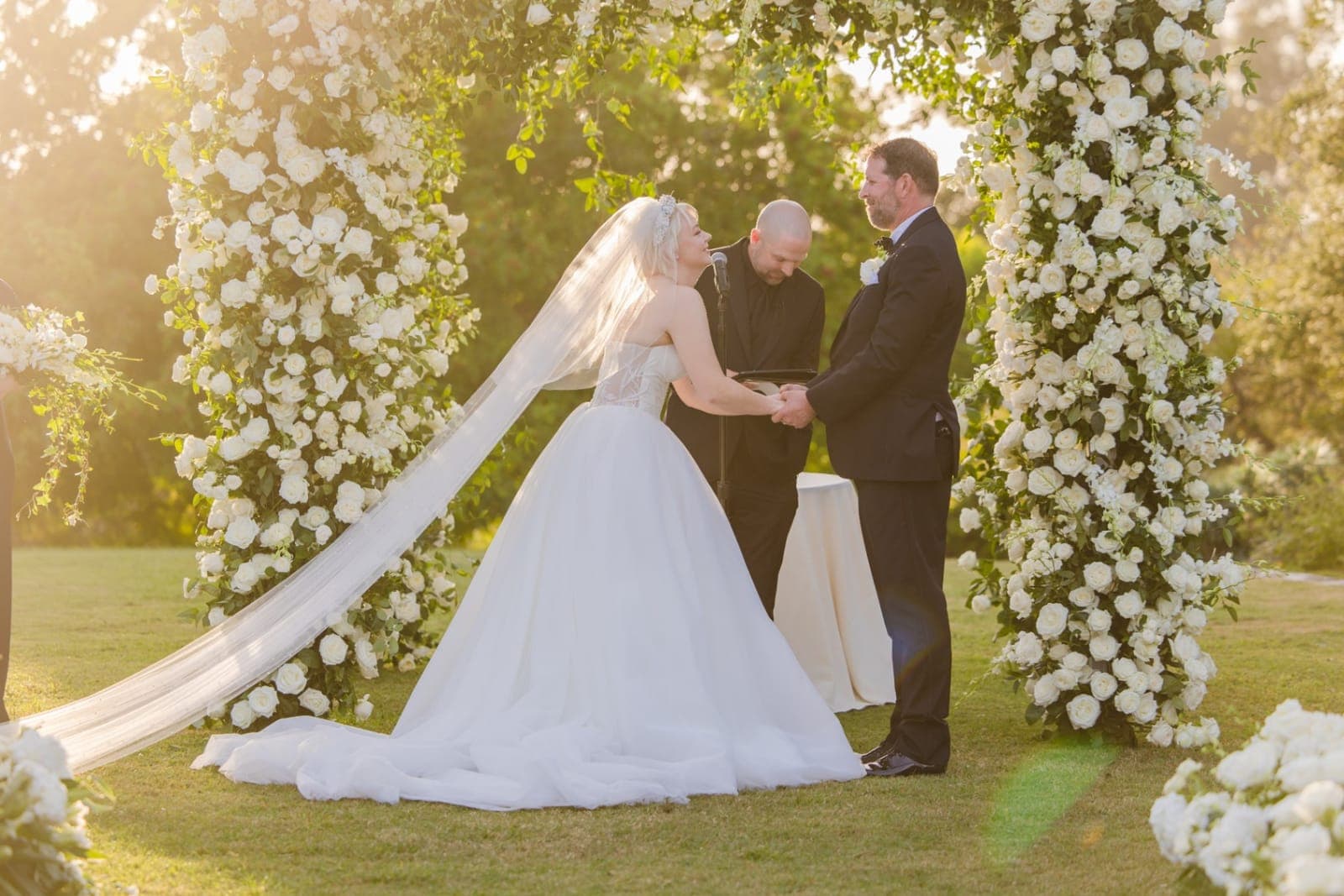
CHIC Flowers is a luxury wedding florist in San Diego and Los Angeles, featured in Vogue, Brides and Haute Living. It uses Fiory, including the AI agent, and its Fiory-built website organizes the portfolio venue by venue. Its main site, chicflowers.com, grew from a five-page portfolio to more than 150 pages, including 40 venue pages.
It also teaches the path this page describes. Chic Academy is its online school for retail florists ready to break into weddings, covering consultations, pricing and execution, taught by a working wedding florist.
- pages on chicflowers.com
- 150+
- venue pages
- 40
- featured in
- Vogue, Brides, Haute Living
chicflowers.com ↗Its Fiory website ↗Chic Academy ↗Read the case study →More florist sites built with Fiory →
Full disclosure: CHIC Flowers is the studio of Fiory's founder.
Start your floral journey with Fiory
You do not need software to learn floristry. You need good pricing habits from the start, and a system the day people start paying you. Here is what Fiory gives you at each stage.
1. While you learn
18 free florist calculators
Price a bridal bouquet, a centerpiece or a ceremony arch from wholesale stem costs, labor and markup. Free, in your browser. Practise on real numbers before anyone pays you.
Open the calculators →2. While you learn
Lens: price any arrangement photo
Upload a photo of an arrangement. Lens names the flowers, counts the stems and works out wholesale cost, labor, markup and a retail price. Free.
Try Lens →3. Your first paid wedding
The AI agent prices it from your numbers
Paste a couple's email and their inspiration photos into Fiory. The AI agent creates the client and the event, picks pieces from your library, writes stem-by-stem recipes for new ones and prices everything from your own costs, labor and tax. A new piece is priced at 3 times its flowers, supplies and labor, rounded up to the next $5, and marked for you to review. Nothing reaches the couple until you send it.
See how the AI agent works →4. When you open your studio
Proposal, contract, payments and website in one plan
Send the proposal, have the contract signed online, take deposits into your own Stripe account and publish a florist website on your own domain. One plan, $138 a month after a 14-day free trial, with 20 AI credits a month.
Start the 14-day free trial ↗
Questions people ask
On the education route, the AIFD exam fee is $179, plus your course fees. On the PFDE route, AIFD estimates about $2,250 plus travel, and the required textbook is $129. Keeping the CFD costs $244 a year in dues ($194 early bird).
It depends on the route. Education-route candidates apply in two windows a year and take the online test within two weeks of access. The PFDE runs once a year, and results generally arrive within 4 to 8 weeks.
Yes. College students in a Student AIFD chapter can be recommended through the student competition, and students at AIFD Education Partners can be submitted by their instructor. Both then take AIFD's online test.
It is the best-known proof of design skill in the U.S., useful for teaching, competing, job changes and marketing a studio. It is not required to work as a florist, and it does not cover the business side.
Not a floral certification. Business registration, sales tax and insurance requirements depend on your state and city, so check with them before you take paid work.
Sources, checked November 2026
Wages, program details and certification rules change. Check the source before you enroll, apply or pay a fee.
- American Institute of Floral Designers (AIFD): Becoming a CFD
- AIFD: Professional Floral Design Evaluation (PFDE)
- AIFD: PFDE registration information (2027, St. Louis)
- AIFD: Education Partners
- AIFD: SAIFD Student Competition
- AIFD: 2026 Symposium, Elevate
- TSFA: floral designer certification, Level 1 and Level 2
- Texas State Florists' Association (TSFA): high school certifications
- TSFA: Texas Master Florist certification
- Texas Education Agency: 2025–2030 Industry-Based Certification list
- Utah State Board of Education: Floriculture CTE strand
- Arizona State Florists Association: Arizona Master Florist
- Society of American Florists (SAF): American Academy of Floriculture
- SAF: Professional Floral Communicators–International (PFCI)
- BLS Occupational Outlook Handbook: How to Become a Floral Designer