
The four parts of a floral design curriculum
Whatever the credential, programs build on the same foundations, usually in this order, with an internship or practicum at the end.
- Design: elements and principles, mechanics (wiring, taping, foam and foam-free), styles and composition
- Plants: flower and foliage identification, conditioning, care and handling, storage
- Specialty work: personal flowers, sympathy, weddings, holidays and large-scale event design
- Business: buying, pricing and markup, merchandising, marketing and shop or studio management
- Practice: internships, a campus shop or a capstone, from about 50 to 480 hours
Sample course sequences, 2026–27
From the programs' current catalogs and program pages. Each program in our school directory links to its own page.
| Program | Credential | What the sequence covers |
|---|---|---|
| Cuyamaca College (CA) | A.S., 33 major units | Floral Design I and II, Wedding Design I, Special Occasion Floral Design, horticulture and plant materials, cooperative work experience, one business course and electives; each design course is 2 hours of lecture and 3 of lab a week |
| Santa Rosa Junior College (CA) | Certificate, 18 units over 4 semesters | Beginning to advanced design, Retail Flower Business Management, display, flower ID and care, flowers to wear, wedding design and floral tributes |
| Front Range Community College (CO) | Certificate, 18 credits | Introductory design (including purchasing and pricing), advanced design (events, weddings, sympathy), career math, horticulture, a 3-credit internship and a 4-credit capstone |
| Coastal Pines Technical College (GA) | Technical certificate, 14 credits | Introductory and advanced floral design, Flower Shop Management, and an internship or elective |
| Gateway Technical College (WI) | Certificate, 12 credits | Floral Design I, Horticulture Marketing, Floristry and Horticulture Events |
| Bucks County Community College (PA) | Noncredit certificate, 102 core hours | Floral Design 1 to 3, principles and elements, two wedding courses and sympathy, then electives and a hands-on final evaluation |
| University of Missouri (online) | Undergraduate certificate, 14 credits | Introduction, everyday, special occasion and wedding design, and Retail Floral Management, including a business plan, website and social media presence |
| FlowerSchool New York | Certificate, 148 hours in 6 weeks | Design, wiring, large-scale installations, sympathy, a flower shop series, a wedding series with client intake and proposals in florist software, photography and marketing, and a 50-hour internship |
| New York Botanical Garden | Certificate, 142 hours | Form, style, color theory, flower ID, wedding design, sympathy, grand-scale design, shopping the New York flower market and event planning, plus an 80-hour internship and a portfolio |
What AIFD's certification expects
AIFD Education Partners agree to teach to AIFD's curriculum objectives, with The AIFD Guide to Floral Design (3rd edition, 360 pages) as the main textbook. The objectives name 45 design styles, 42 flowers and 17 foliages to identify, and 26 design techniques, from binding and clustering to pavé and spiraling.
The written objectives include a shop management unit: "Complete a retail pricing calculation based on mark-up of the cost of goods sold" and "Compute the addition of a labor charge." Pricing is part of the certification curriculum, not an optional extra.
| Category | Examples of what candidates must make |
|---|---|
| Arrangement | Round and oval centerpieces, symmetrical and asymmetrical triangles, with mechanics chosen for stability and weight |
| Wedding | Hand-wired, foam-holder and hand-tied bridal bouquets: crescent, cascade, round |
| Sympathy | Casket sprays, easel wreath, standing spray, basket |
| Flowers to Wear | Corsages, boutonnieres, headpiece, wristlet, floral jewelry |
| Designer's Choice | Any style from the Guide, with the right mechanics |
High school CTE standards
Many states teach floral design in agriculture CTE, built on the national AFNR Plant Systems standard to "apply principles of design in plant systems to enhance an environment." Pricing and markup appear in most of the state frameworks we read; digital marketing appears in the newer ones.
| State | Course | Business and technology content |
|---|---|---|
| Florida | Floral Design and Marketing: four one-credit courses, grades 9–12 (2026–27) | "Calculate mark-up," pricing and selling, computer wire service, internet advertising, a professional digital footprint, opening and managing a shop |
| Tennessee | Floral Design and Operations, grades 10–12, 1 credit (2022) | Suggested retail prices, event proposals with budgets, social media advertising, a business plan, fixed and variable costs, purchase orders and invoices |
| Texas | Floral Design, grades 9–12, 1 credit | Floral business management alongside design and botany |
| Utah | Floriculture, grades 9–12, 0.5 credit | Markup and pricing of floral work; ends with a skill certification test |
| Georgia | Floral Design and Management (2013 standards) | A team florist business with social media marketing, buying and pricing |
| Missouri | Floristry instructional framework | Shop operations, including calculating the price of floral products |
| Oklahoma | Florist Assistant credential | A 55-question exam: care, plants, design, selling, delivery and store upkeep |
Where technology and AI fit in 2027
None of the floral catalogs we checked has a credit course with AI in its title. Technology is arriving through other doors. FlowerSchool New York teaches client intake and proposals in florist software, iPhone photography and content marketing. Missouri's online certificate builds a website and social media presence. BYU-Idaho's program page describes AI-generated images for bridal and funeral consultations, and AI-generated spreadsheets for budgets and inventory.
Industry education is moving faster: SAF offers a NotebookLM for Florists course, and AIFD's 2026 Symposium ran "AI + Floristry: From Concept to Creation." Schools are following. California's community colleges have made AI literacy "a foundational learning outcome across disciplines," and in an EdWeek survey of 472 CTE educators, nearly one-third expected new offerings in digital technology and AI.
A four-lesson AI module for floral programs →AI in floristry →
Practical constraints for instructors
Fresh flowers make floral design one of the most expensive lab subjects. What programs publish:
- Materials: Bucks County lists $150 to $375 in materials per core course; Mt. San Antonio College is tuition-free but estimates $300 to $400 in materials per course; Longwood Gardens puts its full certificate at about $8,000
- Contact time: Cuyamaca's 3-unit design courses meet for 2 hours of lecture and 3 hours of lab a week
- Class size: FlowerSchool New York caps classes at 14 students
- Sourcing: New York Botanical Garden requires a course on shopping the New York flower market, and Mississippi State's students work in the department's own University Florist
- Internships: Cuyamaca counts 54 hours of work experience per unit, the New York Botanical Garden requires 80 hours and Mississippi State 400 to 480
A model sequence for 2027
Our suggestion, built from the programs and standards above. It keeps the design core every program teaches and gives the business side, including software and AI, a course of its own.
| Term | Course | Covers |
|---|---|---|
| 1 | Design fundamentals and care | Elements and principles, mechanics, flower ID, conditioning and handling |
| 2 | Personal flowers and sympathy | Corsages, boutonnieres, casket sprays, wreaths, everyday arrangements |
| 3 | Wedding and event design | Bridal bouquets, ceremony and reception pieces, installations, client consultations |
| 4 | Studio business, software and AI | Pricing from cost of goods plus labor, proposals, contracts and deposits, buying, marketing, responsible AI use |
| Capstone | Internship or campus shop | Real orders and real clients, with a portfolio of priced work |
Funding for floral programs
The American Floral Endowment's educational grants normally range from $500 to $10,000 a year, are due June 1 and do not cover equipment; its Phillip Scholarship Grant Fund gives institutions with floral design programs money for student tuition. In Texas, TSFA certifies high school floral design teachers at two levels, each worth 9 CEUs.
Florists using Fiory
A working wedding studio that also teaches
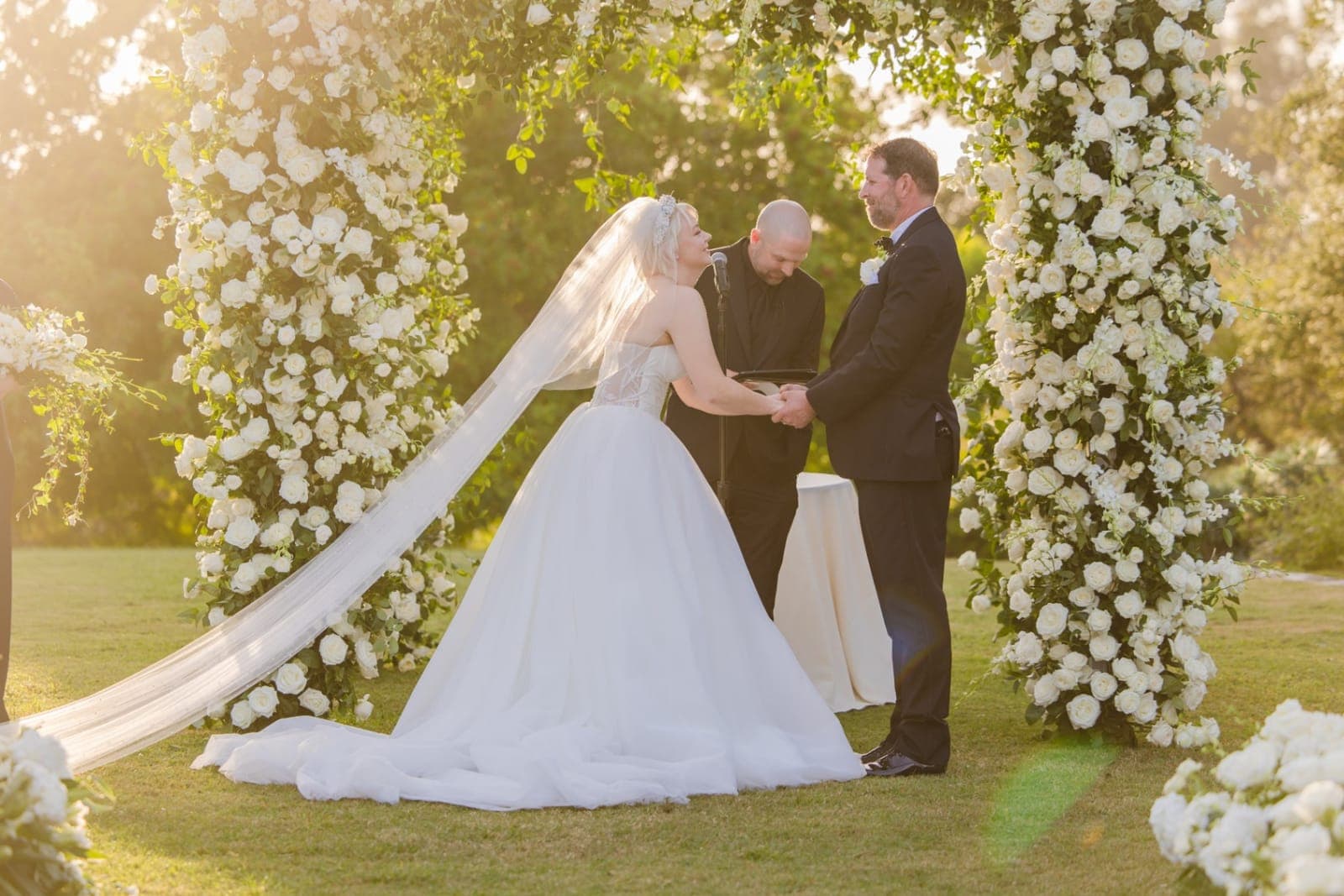
CHIC Flowers is a luxury wedding florist in San Diego and Los Angeles, featured in Vogue, Brides and Haute Living. It uses Fiory, including the AI agent, and its Fiory-built website organizes the portfolio venue by venue. Its main site, chicflowers.com, grew from a five-page portfolio to more than 150 pages, including 40 venue pages.
It also runs a school. Chic Academy is its online program for retail florists ready to break into weddings, covering consultations, pricing and execution, taught by a working wedding florist.
- pages on chicflowers.com
- 150+
- venue pages
- 40
- featured in
- Vogue, Brides, Haute Living
chicflowers.com ↗Its Fiory website ↗Chic Academy ↗Read the case study →More florist sites built with Fiory →
Full disclosure: CHIC Flowers is the studio of Fiory's founder.
Use Fiory in your classroom
Everything below exists today. The program we are building for schools will add to it; tell us what your students need.
1. Pricing labs
18 free florist calculators
Price a bridal bouquet, a centerpiece or a ceremony arch from wholesale stem costs, labor and markup. Free, in your browser. Students can check their own recipes against real wholesale math.
Open the calculators →2. Costing exercises
Lens: price any arrangement photo
Upload a photo of an arrangement. Lens names the flowers, counts the stems and works out wholesale cost, labor, markup and a retail price. Free. A quick way to discuss stem counts, labor and markup from any photo.
Try Lens →3. Business and AI unit
A ready-to-teach AI module
Our outline for a four-lesson unit on AI in a floral business: pricing, proposals, contracts and responsible use, with activities and an assessment rubric.
Read the module outline →4. For your program
Join the schools interest list
Tell us about your program, your students and what you would want from Fiory. We will contact instructors on the list as the program takes shape.
Join the interest list →
Questions people ask
Design principles and mechanics, flower identification and care, specialty work such as weddings, sympathy and events, and usually the business side: pricing, buying, marketing and shop management. Many programs end with an internship.
In the 2026–27 catalogs we checked, credit certificates run from 12 to 18 credits; Cuyamaca College's A.S. needs 33 major units plus general education. Noncredit certificates are measured in hours, such as Bucks County's 102 core hours.
Not as a dedicated credit course in any catalog we checked. BYU-Idaho's program page describes AI-generated images and spreadsheets, and SAF and AIFD teach AI to working florists. Our free module outline helps instructors add a unit.
AIFD Education Partners teach to AIFD's curriculum objectives and can recommend students for the CFD. Other programs cover similar ground; check whether yours is a partner if certification matters to you.
Design principles and mechanics, plant ID, care and handling, specialty designs and floral business basics such as pricing and markup. Florida, Tennessee and Georgia also include social media or internet marketing.
Sources, checked November 2026
Wages, program details and certification rules change. Check the source before you enroll, apply or pay a fee.
- Cuyamaca College: Floral Design A.S. and Certificate of Achievement (2026–27 catalog)
- Cuyamaca College: Floral Design Operations Certificate (2026–27 catalog)
- Santa Rosa Junior College: Floral Design program of study
- Front Range Community College: Floral Design Certificate (2026–27 catalog)
- Coastal Pines Technical College: Floral Designer FD11
- Gateway Technical College: Professional Floral Design curriculum sheet (2026–27)
- Bucks County Community College: Floral Design Certificate courses and fees
- University of Missouri: Floral Artistry and Management certificate
- FlowerSchool New York: 6-Week Floral Design Program (2027)
- New York Botanical Garden: Floral Design Certificate
- BYU-Idaho: Floral Design A.A.S. (includes AI in Floral Design)
- Longwood Gardens: Floral Design Certificate (2026–27)
- Mt. San Antonio College: Vocational Floral Design
- Mississippi State University: Floral Management studies
- AIFD: Education Partner application and CFD curriculum objectives (2025–26)
- Schiffer Publishing: The AIFD Guide to Floral Design (3rd edition)
- National Council for Agricultural Education: AFNR Career Cluster Content Standards (2015, Connecticut edition)
- Florida Department of Education: Floral Design and Marketing framework 8012100 (2026–27)
- Tennessee: Floral Design and Operations course standards (2022)
- Texas Administrative Code, 19 TAC §127.53: Floral Design (One Credit)
- Utah State Board of Education: Floriculture CTE strand
- Georgia Department of Education: Floral Design and Management standards (2013)
- Missouri DESE: Floristry instructional framework
- Oklahoma CareerTech: Florist Assistant credential 6201
- SAF Floral Education Hub: NotebookLM for Florists course
- AIFD Elevate 2026 Symposium brochure (AI sessions)
- California Community Colleges: AI workplan accomplishments (May 2026)
- EdWeek: Are K-12 CTE programs keeping up with AI skills? (November 2025)
- American Floral Endowment: educational grants
- TSFA: Just for Teachers (teacher certification and curriculum)